
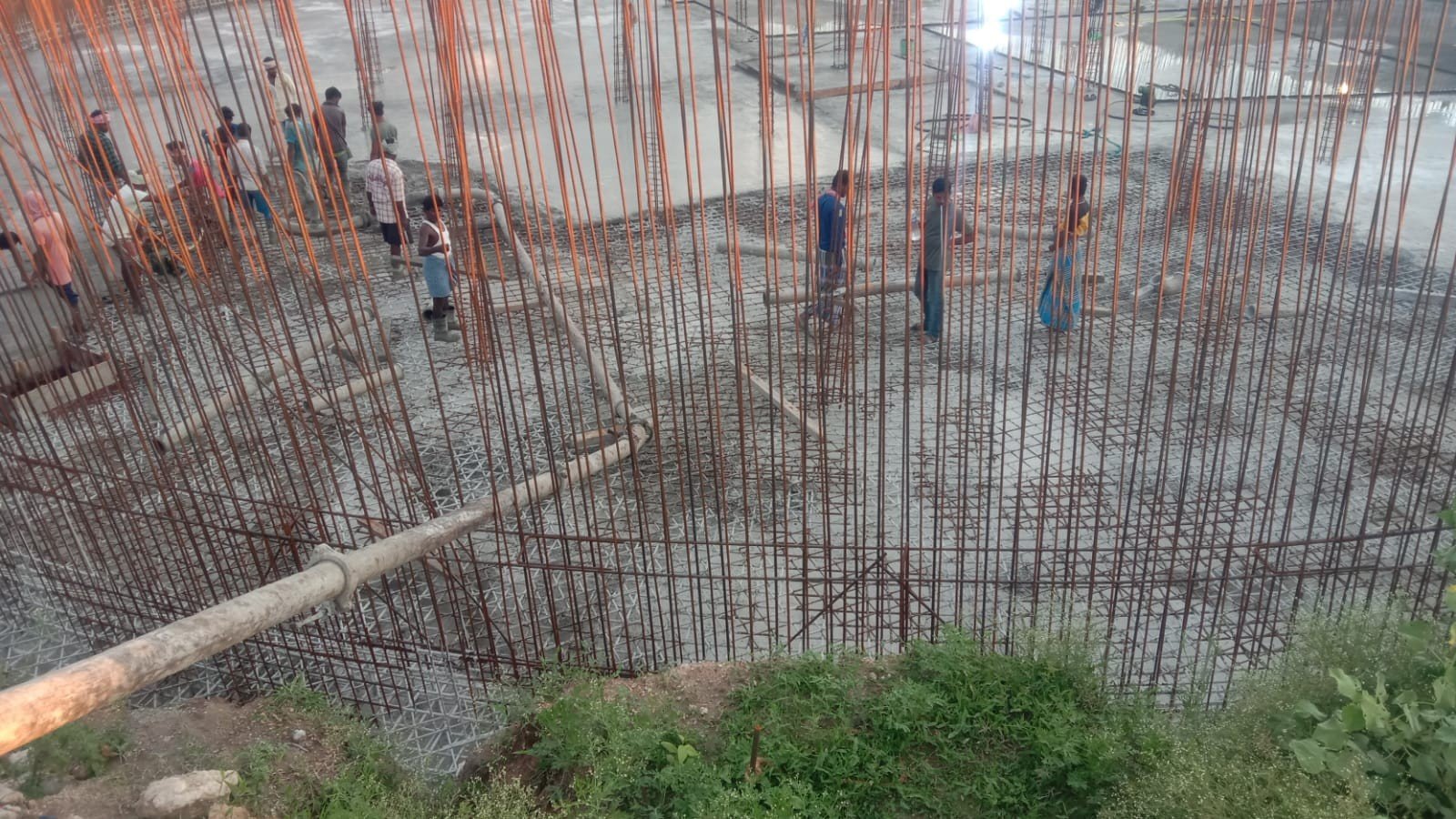
Direct Summary: Ready mix concrete is a perishable product that undergoes rapid chemical hydration. Managing delivery logistics, transit windows, and site layout preparation is essential to prevent cold joint formations and control pouring quality in hot tropical regions like Trichy.
1. The 120-Minute Hydration Rule
The chemical hydration reaction starts the moment water is mixed with cement at the batching plant. Under standard civil engineering specifications, concrete must be fully discharged, placed, and compacted within **120 minutes** of batching. In hot climates, where ambient temperatures often exceed 35°C, this hydration window can shrink to **90 minutes** due to faster water evaporation.
To extend workability, our QC laboratory adds specialized **hydration-delaying admixtures (chemical retarders)**. These retarders slow down the initial set, maintaining workability for up to 3 to 4 hours, which provides a safe window for transit and placement.
2. Coordinate Shuttering and Rebar Readiness First
Never schedule a concrete delivery until the shuttering formwork is fully erected, leak-sealed, and the rebar steel grids are verified by your structural consultant. Shuttering must be cleaned of dust and wet down with water before the pour. Dry wooden shuttering absorbs water from the fresh concrete mix, altering the water-cement ratio and causing structural cracks along the bottom of the slab.
3. Site Access and Transit Mixer Clearance
A fully loaded 10-wheel transit mixer weighs approximately **26 tons**. You must ensure that:
- The site access road is structurally capable of supporting heavy truck loads.
- Overhead power lines and trees provide at least 4 meters of vertical clearance.
- Sufficient space is available for the transit mixer to turn and align with the concrete pump hopper.
If access is restricted, notify our plant supervisor in advance so we can dispatch smaller, highly maneuverable 6-wheel mixers.
4. Managing Consecutive Deliveries (Pour Pacing)
For large continuous pours (such as raft foundations or large slabs), concrete must be delivered in continuous intervals. If the gap between transit mixers exceeds 45 minutes, the previously poured layer will begin to set, forming a **cold joint** (a weak plane where two layers fail to fuse). Our dispatch supervisors coordinate with site managers, adjusting travel intervals based on local traffic conditions and concrete pumping speeds.
5. Pre-Pour Logistics Checklist for Site Managers
- Confirm that the concrete pump operator is on-site and the pump lines are primed with a cement slurry.
- Verify that needle vibrators are operational and a backup vibrator unit is available on-site in case of mechanical failure.
- Assign a dedicated worker to receive and verify the batch tickets and QC specimens.
- Check the local weather forecast; avoid scheduling pours during heavy monsoon downpours unless adequate tarpaulin sheets are prepared to cover the fresh concrete.