
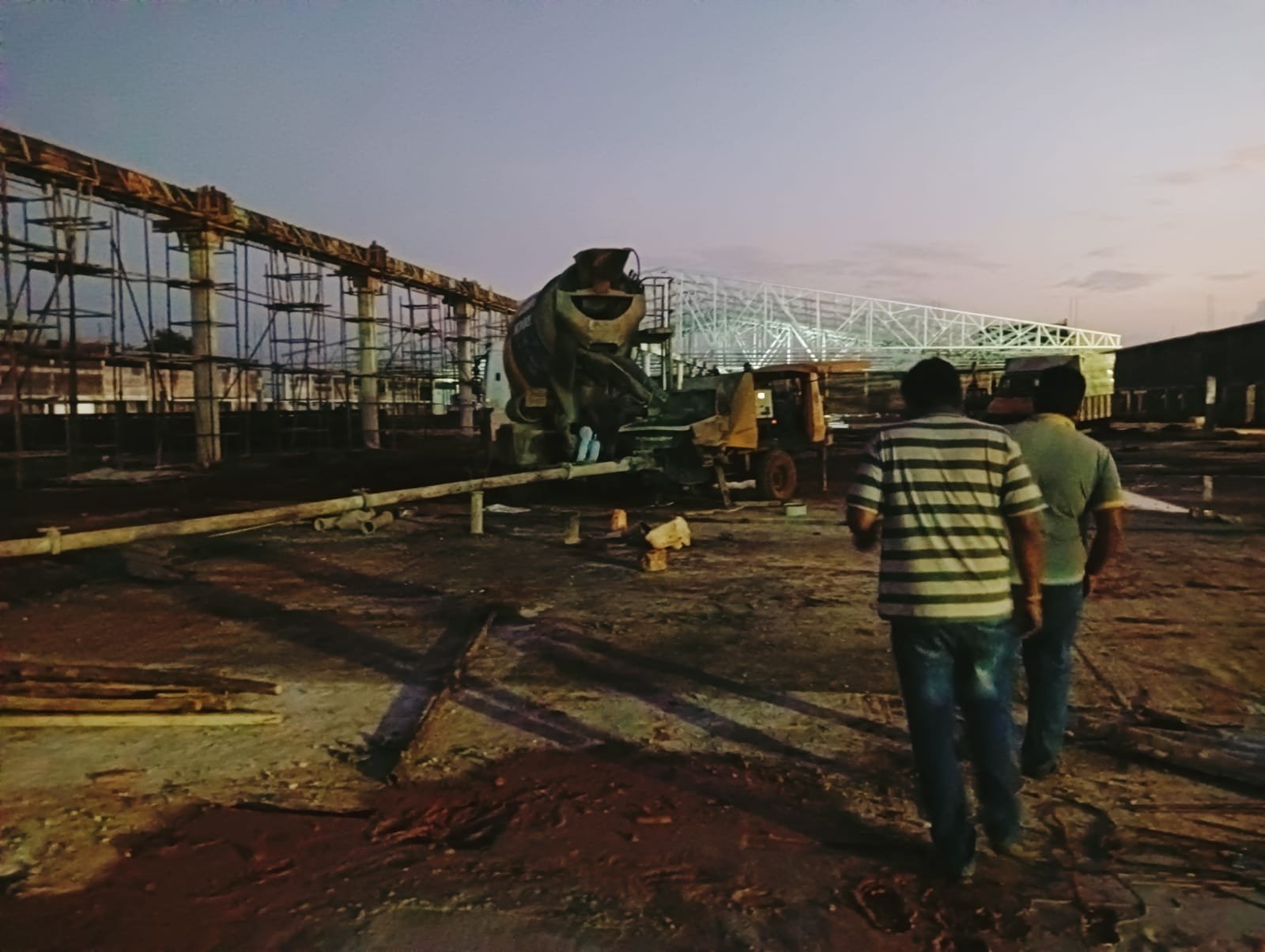
Direct Summary: Self-Compacting Concrete (SCC) is a highly fluid mix design that flows under its own weight, completely filling shuttering formwork and encapsulating dense steel reinforcement grids without requiring mechanical vibration. It eliminates internal honeycombing defects and reduces site labor costs.
1. Rheology: How Self-Compaction Works
Traditional concrete is highly viscous and requires needle vibrators on-site to release trapped air pockets. If vibro-compaction is insufficient, voids and honeycombing can occur, exposing steel rebars to oxygen and water, which causes rust and structural degradation.
SCC behaves like a dense fluid. It is designed using a high volume of cementitious fines (such as fly ash or ground granulated blast furnace slag) combined with **polycarboxylate ether (PCE) superplasticizers** and **viscosity-modifying agents (VMAs)**. The superplasticizers disperse cement particles to maximize flow, while VMAs prevent segregation, keeping heavy aggregates suspended in the paste during flow.
2. Workability Tests for SCC Compliance
Standard slump tests are not suitable for evaluating SCC. Instead, our quality control laboratory uses three specialized tests to ensure workability and stability:
- Slump-Flow Test: Measures the horizontal spread diameter of the concrete. Standard target values for SCC range between 650 mm and 800 mm.
- V-Funnel Test: Measures the time required for a set volume of concrete to flow out of a V-shaped funnel. Target times range between 6 and 12 seconds, indicating appropriate filling ability.
- L-Box or J-Ring Test: Evaluates passing ability by measuring how easily the fluid mix flows through narrow steel rebar gates without blockages.
3. Key B2B Applications for SCC
Self-compacting concrete is widely specified for complex architectural and B2B civil structures, including:
- Congested Rebar Columns: Multi-story columns with dense vertical steel reinforcement grids where needle vibrators cannot reach.
- Shear Walls: Thin concrete partitions that require smooth surface finishes without air pocket blemishes.
- Pre-cast Concrete: Pre-fabricated beams and retaining walls where speed of placement and rapid turnaround are required.
4. Cost-Benefit Analysis
While SCC carries a higher material rate per cubic meter due to its premium PCE superplasticizer formulation, it offers significant B2B cost savings on-site:
- Labor Savings: Reduces the placement crew size by eliminating the need for vibrator operators.
- Reduced Noise: Pours are quiet, allowing for night operations in noise-sensitive residential zones in Trichy.
- Superior Durability: Dense microstructures offer high resistance to water penetration, extending the building life cycle.